

KeylessUniversal
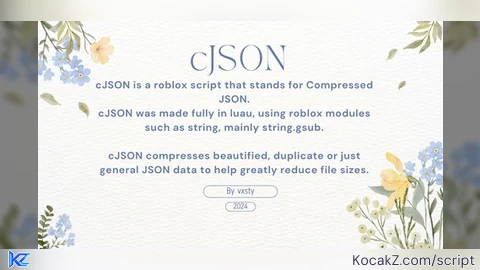
-- cJSON: A new file extension which stands for compressed json.

local gsub, format, rep, sub, split, match, gmatch = string.gsub, string.format, string.rep, string.sub, string.split, string.match, string.gmatch;
local tinsert = table.insert;
local floor = math.floor;

local tostring, tonumber = tostring, tonumber;

-- * Base62 Start (Useful for number compression.)

local base62_chars = "0123456789abcdefghijklmnopqrstuvwxyzABCDEFGHIJKLMNOPQRSTUVWXYZ"

local base62 = { -- Very useful for compressing numbers, Can reduce sizes heavily when handling big numbers, for example: 1234567890 (#10) -> 1ly7vk (#6) which is 4 bytes shorter.
  index = {};
}

for i = 1, #base62_chars do
    base62.index[sub(base62_chars, i, i)] = i - 1
end

function base62.encode(num)
    local str = tostring(num);
    if #str == 1 then return str end -- Numbers like 1, 2, 3, 4, 5, 6, 7, 8, 9, 0 always return "(number)" so we can just do that.
    num = tonumber(num);

    local result = ""
    while num > 0 do
        local remainder = num % 62
        result = sub(base62_chars, remainder + 1, remainder + 1) .. result
        num = floor(num / 62)
    end

    return result
end

function base62.decode(str)
    local result = 0

    for i = 1, #str do
        local char = sub(str, i, i)
        local value = base62.index[char]
        result = result * 62 + value
    end

    return result
end

local cJ = {
    characters = {
        [" "] = utf8.char(1),
        other = utf8.char(2),
        numbers = utf8.char(3)
    }
};

local re = {
    sub = function(string, pattern, replacement) -- Allows you to use the quantifier ((a){2} -> aa)
        pattern = gsub(pattern, "%((.+)%){(%d+)}", function(a, b)
            return rep(a, tonumber(b))
        end)

        return gsub(string, pattern, replacement)
    end,
    secure = function(string) -- Fixes regex pattern matching, Returns a regex safe string, example: string: hi-world, Output: hi%-world
      local StrList = "$%^&*()-+[]?.";
      local List = {};

      for _, Letter in next, split(StrList, "") do
        List[Letter] = "%" .. Letter
      end

      return gsub(string, ".", List)
    end
}

function cJ:Compress(Raw)
    local start = tick();
    local Text = gsub(Raw, "\n", "")

    -- * Arrays and Dictionaries Compression start

    Text = gsub(Text, "([{%[])(.+)([}%]])", function(s1, a, s2) -- I couldn't make files even smaller because of some regex issues, I was aiming to make it gsub ".+": to .+: but due to some greedy regex issues i couldn't do that.
        a = gsub(a, '":%s*', '":')
        a = gsub(a, '%s*"', '"')

        return s1 .. a .. s2;
    end)

    -- ! Arrays and Dictionaries Compression end

    -- * Letter + Space Compression start

    Text = gsub(Text, "(%s+)", function(Spaces)
        if #Spaces <= 2 then -- Because doing 1 character and a number is already 2 characters which wont make a difference
            return Spaces
        end

        return cJ.characters[" "] .. #Spaces
    end)

    local LastLetter = ""
    local CurrentSequence = ""
    local LetterHistory = {}

    for i, Letter in next, split(Text, "") do
      if Letter == LastLetter then
        CurrentSequence = CurrentSequence .. Letter
      else
        if #CurrentSequence > 3 then
            LetterHistory[LastLetter] = LetterHistory[LastLetter] or {}
            tinsert(LetterHistory[LastLetter], {start = i - #CurrentSequence, length = #CurrentSequence, sequence = CurrentSequence})
        end
        CurrentSequence = Letter
      end
      LastLetter = Letter
    end

    for Letter, Data in next, LetterHistory do
      for _, LetterData in next, Data do
        local StartIndex, EndIndex = LetterData.start, LetterData.start + LetterData.length

        Text = sub(Text, 1, StartIndex) .. Letter .. cJ.characters.other .. tostring(LetterData.length) .. cJ.characters.other .. sub(Text, EndIndex)
      end
    end

    -- ! Letter + Spacing Compression end

    -- * Number Compression Start

    Text = gsub(Text, "%d+", function(Number)
      local encoded = base62.encode(Number);
      local char = cJ.characters.numbers

      if #Number > #encoded + 2 then -- + 2 is because of the 2 bytes we're adding (cJ.characters.numbers) to mark the base62
        return char .. encoded .. char
      end
    end)

    -- ! Number Compression end

    return {BytesCompressed = #Raw - #Text, Result = Text, TimeTaken = tick() - start}; -- BytesCompressed: How many bytes the script managed to remove without data loss, Result: The compressed result, TimeTaken: How long it took to compress (IN MILLISECONDS!)
end

function cJ:Decompress(Text)
    local Raw = gsub(Text, cJ.characters[" "] .. "(%d+)", function(Times)
        return rep(' ', Times)
    end)
    Raw = gsub(Raw, "(.)" .. cJ.characters.other .. "(%d+)" .. cJ.characters.other, function(Data, Times)
        return rep(Data, Times)
    end)
    Raw = gsub(Raw, cJ.characters.numbers .. "(.-)" .. cJ.characters.numbers, base62.decode)

    return Raw;
end

return cJ;

Lmao chatgpt made this
@lelahcolonial453 ???? read the code buddy
@vxsty "please code the script without comments and the ugliest the possible but works" 💔💔
@lelahcolonial453 ??? i made this on roblox studio, chatgpt does not give you such scripts, but since you seem to be experienced with chatgpt make him generate it
those flowers, are just not needed :sob:
@frzfrsy 🥷 WHO are you
@vxsty indian new exploiter, music producer
@frzfrsy the project is over a year old so please read the code before commenting anything (And it's still better than anything you can currently make!)